Drift Fault
Define Fault
A sensor drift fault models a gradual, systematic deviation of sensor readings from their true values over time. Unlike abrupt faults (e.g., spikes or dropouts), drift accumulates slowly and can be difficult to detect without trend analysis.
The drift rate \(r \in \mathbb{R}\) represents the slope of the fault-induced offset. Larger magnitudes of \(r\) produce faster deviation from the true signal, while \(r = 0\) implies no drift.
Sensors can naturally drift over time due to aging, temperature effects, calibration loss, or environmental exposure.
Math Behind Fault
Assume a univariate time series of true sensor values:
True signal: \(x_i\), for index \(i = 0, 1, ..., N-1\)
Fault start index: \(s\)
Fault end index: \(e\)
Drift rate: \(r\)
Linear Drift Model
The observed (faulty) signal \(y_i\) is defined as:
Key takeaway
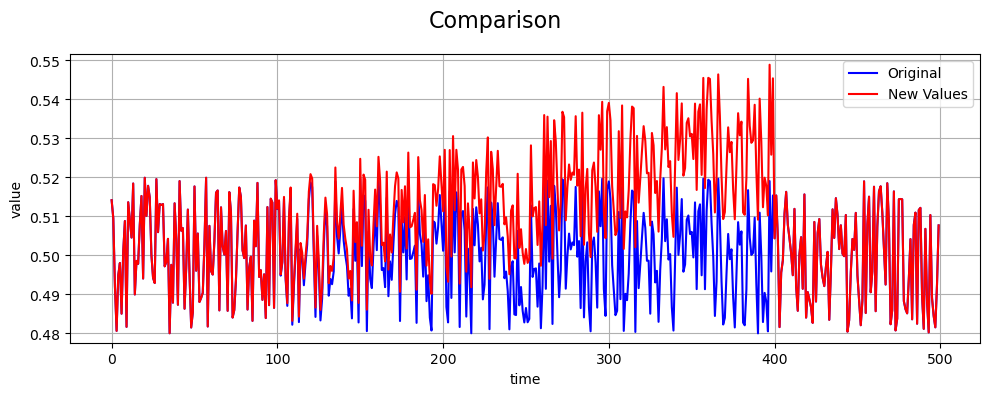
Sensor drift affects both the mean and the variance, shifting the average value while also increasing variability over time.
Example
An example of a drift fault compared to the true values is shown below: