NaN Fault
Define Fault
A NaN fault models a sensor failure where readings are completely
missing for a continuous period of time. During the fault window, the
sensor does not report valid numeric values, and measurements are
represented as NaN (Not a Number).
NaN faults commonly occur due to communication dropouts, power failures, buffer overflows, or temporary sensor disconnections. Unlike additive faults (e.g., bias or drift), NaN faults do not alter the underlying signal values—they remove them entirely from observation.
Math Behind Fault
Assume a univariate time series of true sensor values:
True signal: \(x_i\), for index \(i = 0, 1, ..., N-1\)
Fault start index: \(s\)
Fault end index: \(e\)
Linear NaN Model
The observed (faulty) signal \(y_i\) is defined as:
Key Takeaway
NaN faults preserve the underlying statistical properties of the signal but reduce the effective sample size and may cause failures in algorithms that do not explicitly handle missing data.
Example
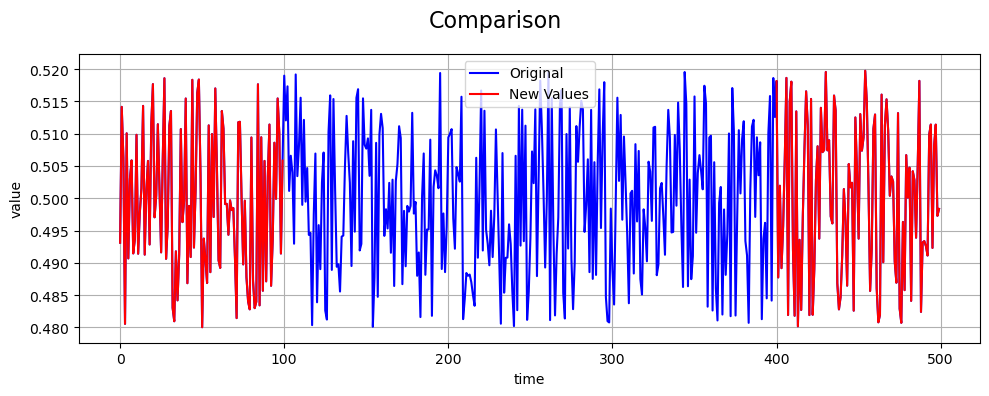
An example of a NaN fault compared to the true values is shown below: